
By Madison Mondell
Triangle Writer

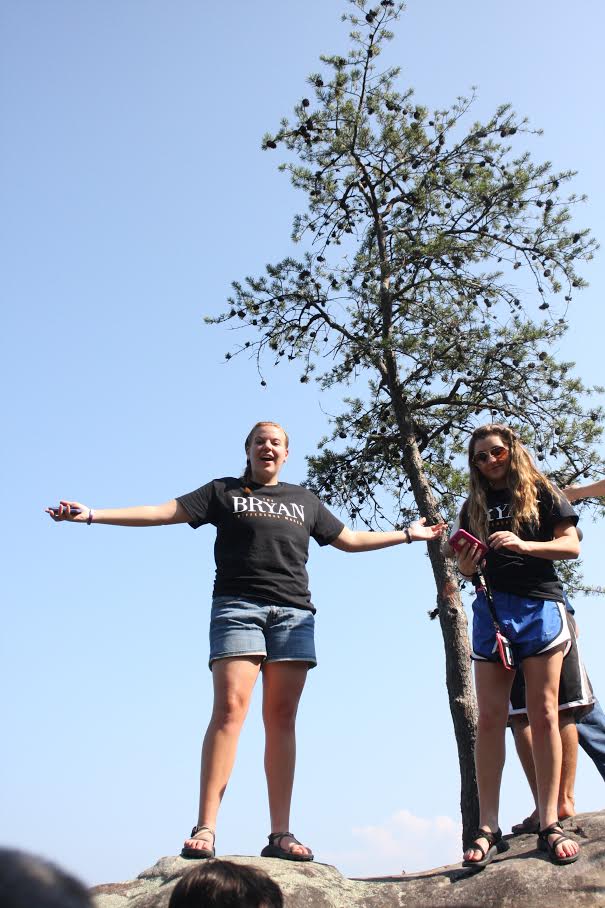
Nate Adams came to Bryan to play soccer. He became known around campus for spoken word poetry. / Photo by Maddie Mondell

Nate Adams came to Bryan to play soccer. He became known around campus for spoken word poetry. / Photo by Maddie Mondell

“I will always watch cartoons over any other movie,” said Nate Adams, senior Communications major, who grew up in Frederick, Maryland, in the same house he was born in. Adams came to Bryan College through his soccer career.

“It was totally a God thing. Soccer and my sister got me here. I was playing at West Virginia and due to financial issues, I was looking to transfer and find a better fit. I asked God to show me where to go and to tell me through where the money was coming and He totally answered me,” said Adams.

After graduating high school, Adams had gone to Sao Paulo, Brazil where he played for a professional club team. While his time there was unpaid, he was able to train with people his age and a little older for 7 months.

“In that time, I played against a really good club and then they wanted me to train with them, so I did. I came back to the states and talked about playing professionally back in Brazil, but the paperwork for my work visa didn’t end up working out. My dad told me to go to a community college and play locally, and then I got swept into West Virginia.”

But soccer isn’t the only talent Adams has in his arsenal; Adam has also recently gotten involved in spoken word poetry.

“The first poems I ever wrote were to girls; they weren’t sincere. I don’t think that they were beautiful, but merely simple words put together. That was between 15 and 18, then I stopped writing for awhile,” laughed Adams.

Adams shared about how he was watching YouTube videos about spoken word, researching into the idea, when his dad leaned over his shoulder and told him that he should try it.

“My dad said that this was something he thought I could do and that it was a way to share my story,” said Adams. The first spoken word piece Adams wrote was his testimony.

“After that, I started seeing more spoken word develop on the Internet, and I contacted a couple of the artists and asked them how I could improve. They told me to start writing about my experiences and to pray hard about it, to pray that God gives me the poetry and the potency. I started writing from what I know and what I see in the world.”

When asked about whether spoken word was something he’s be interested in pursuing, Adams said that he would love to pursue it professionally.

“I would love to be like Micah Bournes or Propoganda and travel and share my words. That would be a huge blessing. I don’t think I could ever not write,” admitted Adams.

But what are the weird or the unknown things about Nate Adams?

“I love the game Rush Hour and I’m a momma’s boy. I love shoes: they can make or break an outfit, and I can take longer to dress in the morning than any girl. I am also very, very stingy with my words. It can come down to simple words like “friend” or “love” or “grace”. Words that can often lose their definition, words that we have a tendency to throw around. I also love to dig deep on ideas, like in theology, and I will always go to the –nth degree on an issue.”

Adams has a couple options for his future once he graduates in May, and a couple ideas for what he wants to do.

“I have a semi-pro contract in Chattanooga with the Chattanooga Football Club. I have a game on graduation day, actually. During the summer I’ll be working at the YMCA, working and coaching to suffice an internship. Not too many ideas after that, but there’s a potential job interest in sales or marketing. I want to move back to Maryland and serve my church, be wherever God can use my gifts. I have an extreme desire and burden to help the church. I also want to start putting videos up on Youtube while I’m still here at Bryan.”

I asked Adams if there was anything else I should be asking him, and he told me to ask him what he lives by.

“I live by and have adopted the idea from Mr. Palmer about what makes your heart tick. What makes your heart skip a beat? I have also adopted the philosophy of John Calvin, which is to deepen your understanding of God and your understanding of man. I live by the stinginess of guarding my words. I really try to live every moment as if it is not something I deserve, but that it’s all by God’s grace. I want to challenge people that they will never understand grace if they do not understand sin. I try to remain humble, I always submit to God. God gives me gifts, but I gotta give that gift for His glory.”


By Meredith Kreigh
Triangle Writer 

Left to Right: Dean Morgan, Michael Palmer, Michele Pascucci and Jason Glen discuss diversity at a panel on Martin Luther King Jr. Day, Jan. 21. / Photo courtesy of Meredith Kreigh

Dean of Community Life Bruce Morgan said that when he first came to Bryan in 1978, he was one of 13 students of color in the college of 530 students.

“At that time,” he said, “schools were being desegregated. I am not sure if it has really improved that much.”

Students gathered on the second floor of Latimer to hear stories and advice concerning cultural diversity on Martin Luther King Day, Jan. 21. The panel consisted of Morgan, Communications Professor Michael Palmer and Spanish Professor Michele Pascucci, while Assistant Director of Worldview Formation Jason Glen mediated.

The panel provided several different perspectives on race relations around the world.

Each individual echoed what Morgan said: begin with yourself when it comes to dealing with diversity.

South African Palmer, who moved to the Congo at age 2, said “It was very cosmopolitan. There was a very blended set of people. And then I went to Southeastern University (in Lakeland, Fla.) and saw very limited ethnicity.”

“Before I came to the States,” continued Palmer, “I thought this place was much better at diversity. Then I stepped off of the boat and realized that you people were as crazy as us.”

Pascucci spent five years teaching Spanish in Japan. She recalled that people would sometimes point and call her an “outsider.” Most of the discrimination she found was positive.

“I kinda felt like a rock star,” she said.

Glen asked the panel to share how their Christian beliefs influenced the way they saw discrimination.

First to speak, Morgan said that, as a believer, he didn’t have a right to hold onto bitterness.

When Palmer was growing up in the Apartheid, he took a more active resistance to the institutionalized discrimination. Palmer and his peers would watch the police so that people could move about and interact with other people, without police harassment.

“You had to have papers to be in certain areas of South Africa,” Palmer said. “By standing up against that to help my neighbors, I saw an acute sense of justice. Also, graciousness and forgiveness were necessary in interactions.”

When Pascucci met a person who was very different than her, she had to take a step back and analyze her reaction.

While in Spain, Pascucci’s host mother was a card-holding member of the Communist Party.

“I had to ask myself: Are these things wrong because of political affiliation or are they just wrong? You have to bring things like that into dialogue. Learn how to listen.

Palmer offered a tip for students engaging another culture, saying you can only know your own cultural experiences.

“So you have to be respectful,” he said


Wednesday, December 12th, 2012

Communication professors visit the Czech Republic

By Amy Bailey
Staff Reporter

Professor Michael Palmer dines aboard a train in the Czech Republic during his recent visit there. / Photo courtesy Michael Palmer

Exciting new opportunities are brewing in the Bryan College international community for the Communications Department. This past semester Professor Michael Palmer and Dr. Randy Hollingsworth each respectively spent a week in the Czech Republic, in the city of Olomouc, as guest lecturers at Palacký University. Dennis Miller, executive director of external communications, arranged these trips.

Through previous projects in the Czech, Miller formed contact with a communications expert and professor at Palacký named Vaclav Rericha. In the past three years, Rericha has visited Bryan College twice. Students in Palmer or Hollingsworth classes during these times may remember his guest lectures.

During the last three years, Rericha has been establishing a communications department at Palacký University. The Czech Republic has endured a tragic history under the reign of communism. Only recently has the country resolved age-old conflicts and adopted democracy. In their newfound rights, the freedom of speech is a fresh concept, leaving students reluctant to speak up. Miller proposed that it would benefit the Palacký Communications Department to get an American perspective on communication and see an example of how Bryan runs its Communications Department.

In their time at Olomouc, Palmer and Hollingsworth gave excerpts of the courses they teach here; for example, “Popular Culture and Communication”, or “Small Group Communication.” They agreed the most interesting classroom experience they had there was teaching in an interpretation class. As they spoke, the students were simultaneously translating the English lecture into Czech at their desk.

Due to the shame culture that has long been bred in Central Europe, students were timid to speak up or show much action beyond listening and taking notes. This is a strong contrast to Bryan’s discussion style classroom setting. Both Palmer and Hollingsworth said this was a strange adjustment, but said that by the end of their time there, they noticed a considerable warming of the student’s demeanor and heightened communication.

Outside of the classroom both had opportunities to explore their surroundings. Palmer, who visited first, decided to avoid the tourist’s version of Olomouc saying, “I wanted to feel the place, instead of just being in a hotel.” In fact, he stayed in a hostel, called “The Wombat.” He spent his free time bonding with the faculty and students and visiting various historical landmarks – doing his best to enjoy the cultural experience.

Dr. Hollingsworth, who was in the Czech over Thanksgiving break and his thirty-first wedding anniversary, brought his wife along on the trip. While he was in the classroom, a student aide showed Mrs. Hollingsworth around the city. After his days of lecturing, they went to Prague, which Dr. Hollingsworth said was the highlight of their trip.

The thrill of this experience is enhanced by the possibility of it becoming a permanent and recurring relationship in the very near future. Palmer and Hollingsworth are in the planning stages of developing an ongoing connection between the communication departments at Bryan and Palacký. This relationship would involve two-way exchanges of professors and students.

“I think the reason this connection is important, academically and culturally, is because we’re living in a more global environment,” Miller added. “People are becoming increasingly connected globally and for people to be successful, cross-culturally, they have to be able to communicate … The idea of connecting communications departments from different parts of the world potentially has great value.”


Tuesday, October 2nd, 2012

Rugby Club season is back

By Dhember Viera
Staff Reporter

 One of the most beautiful times of the year is approaching. Leaves are slowly

changing colors and falling, and the scent of pumpkin-spice latté is lingering through Mercer. Fall is officially here.

Aside from a beautiful view around campus and chilly nights, fall brings forward many different things to do and sporting events to attend, Bryan College rugby being one.

The Rugby Club returns this year with a team of 22 eager guys excited to knock one another around and come full force against other schools on the pitch.

“Rugby for Dummies”

Rugby is a physical game in which 15 players try to advance a ball toward a goal

line, while the 15 players of the opposing team attempt to stop them. It sounds a lot like American football on the surface. Unlike American football, there are no downs and the ball is in continuous play. In fact, possession is exchanged often and quickly.

There are few long, sustained drives toward the in-goal area, or end zone to American fans. Progress up and down the pitch, or field, is achieved grudgingly and usually in short chunks.

There is extensive contact and a lot of tackling.

“Unlike other sports, rugby doesn’t have sissy time outs,” said Michael Palmer, associate professor of communications and rugby faculty sponsor, when asked about the game.

“Rugby is a very basic level of war without weapons,” Palmer added.

Both Palmer and Col. Ron Petitte, club parent, are experienced rugby players and express a passion for the game, even taking time to coach the Bryan College club.

From off the hill, licensed referee Gareth Daves from Knoxville, Tenn., has been coming once per week to help teach fundamentals and tactics of the game. Bryan College alumni and former rugby team captain, Clayton Schmidt, is current manager for the team and is dedicating a lot of time and helping administer the team.

Unlike many of the team sports and clubs at Bryan, the college does not fund the Bryan College Rugby Club. It is not considered a varsity sport and does not have a budget, nor paid coaches and trainers due to the fact that rugby is such a heavy contact sport and carries a higher risk of liability.

One of the unique things about this team is that it has been around for seven years, making it the longest running club at Bryan.

How do they do it without any school funding?

The guys on the team are extremely dedicated, and when it comes to fundraising events, they have been willing to do whatever it takes. They also seek sponsorships from Dayton businesses.

“I give full credit to the boys,” said Palmer. “They work so hard to be able to do this.”

With the money they earn, the club pays league fees and purchase necessary equipment and uniforms.

The rugby club meets on Monday, Wednesday and Friday at 4:30 p.m. at either open grassy areas around campus or at Cedar Point Park, at the foot of Bryan Hill.

Games are held either at the Rhea Family YMCA football field or the Delaware Avenue Sports Complex in Dayton.

The rugby club is always recruiting. If any men on campus are in the mood to tackle somebody, or want to be a part of the brotherhood and camaraderie that comes with being on a sports team, talk to Palmer, Petitte or any of the current team members. There is an upcoming alumni game under the lights at the YMCA field on Oct. 5.


Wednesday, September 12th, 2012

Communi-ka-palooza set for Friday, Sept. 14

By Will Jones
Staff Reporter

To the uninitiated, Commun-ka-palooza might sound bizarre or even a bit spooky – events include a bonfire, sing-alongs, and the mysteriously titled “African Games”. But according to Randy Hollingsworth, professor of communication studies and chair of the humanities division, the weekend provides a valuable opportunity for comm. students to relax and mingle for a bit before classes and activities devour every extra bit of time and sanity.

This Friday 14, Sept. 14, around 70 communication majors and minors will assemble at Fort Bluff Camp atop Dayton Mountain for the weekend retreat full of food, quality communication and fire.

“It really creates a camaraderie within the department and a sense of belonging, both for freshmen and for the upperclassmen who have been there and done that,” said Hollingsworth. “Students get to see each other and their professors in a more relaxed environment.”

In addition to fun and games, students will learn of the department’s vision for the coming year, Hollingsworth said. There are nearly 80 students in the department, including everything from journalism to theatre to film, so orienting everyone can be a bit like herding cats. The retreat, according to Hollingsworth, allows the department to update students on the doings of their department. In particular, those majoring in communications will be briefed on a new departmental requirement that students observe and participate in three on-campus activities during the semester.

“The idea of a liberal arts school is that we should be equipping our students to take their knowledge and make it a vital part of the overall community,” said Hollingsworth. “So, we’ve added a new requirement that students within the major show that they have contributed before they can register for classes.”

Associate Professor of Communication Studies Michael Palmer was slow to respond when he was asked about the “African games” listed on the event brochure. He named only one, called “leggy” (a rather scandalous name for a Bryan approved activity,) which he said involves “teams, tennis balls, legs and a war without weapons.”

“Other African games involve tracking and killing,” he said to freshman, trying to pull them into the communications department.

Twenty dollars covers food, lodging and an event T-shirt designed by sophomore film student Kayla Snyder. Hollingsworth said students who are considering a comm. major or simply curious to play a game called “leggy” are welcome to come if they contact him first. After playing leggy, singing around a bonfire and spending the night at Fort Bluff, the communication students will return to campus Saturday in time to see the Bryan men’s soccer team take on Point University at 5:00 p.m.